Is Red Sandalwood Farming Legal in Telangana?
Mar 17, 2026
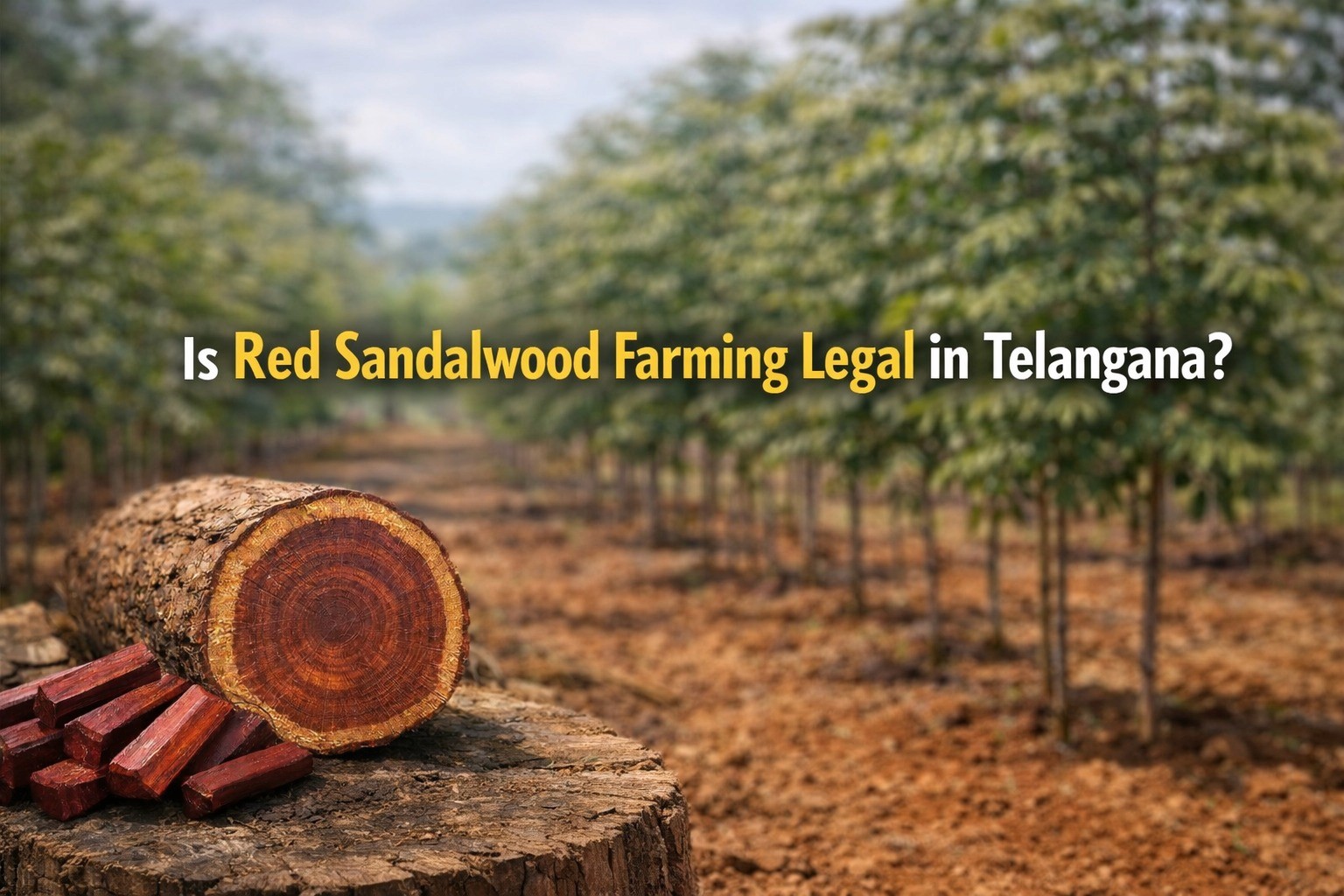
In recent years, red sandalwood has emerged as one of the most talked-about long-term investment opportunities in India. With rising land prices, volatile stock markets, and increasing interest in alternative assets, many investors are exploring farmland as a secure and appreciating investment.
Among all options, red sandalwood farming stands out due to its high market value, global demand, and scarcity. However, before investing, one crucial question arises:
Is red sandalwood farming legal in Telangana?
The answer is yes—but with strict regulations that every investor must clearly understand.
This guide will walk you through everything:
Legal status
Government rules
Permissions required
Investment numbers
Risks and compliance
Legal Status of Red Sandalwood in Telangana
Red sandalwood (Pterocarpus santalinus) is classified as a protected species under Indian forest laws. This is primarily due to:
High international demand
Limited natural growth regions
History of illegal trade and smuggling
Despite this: The government allows red sandalwood cultivation on private land.
This means: You can legally grow red sandalwood in Telangana, but its harvesting, transport, and sale are regulated
Why Red Sandalwood is So Valuable (Key Numbers)
Understanding its value explains why regulations exist:
Market value: ₹8 lakh to ₹40 lakh per ton
Export demand: Extremely high in China, Japan, UAE
Growth cycle: 12–15 years
Trees per acre: 400–600 plants
Survival rate (managed farms): 70–85%
Even a small plantation can become a high-value asset over time
This combination of:
High value
Low supply
Export demand
…makes it one of the most controlled plantation assets.
The first and most important rule:
Red sandalwood can only be grown on private agricultural land
Allowed:
Patta land
Individually owned farmland
Legally registered agricultural plots
Not Allowed:
Forest land
Government land
Encroached land
Clear land ownership documents are mandatory.
While there is no restriction on planting itself, compliance begins from day one.
Recommended practices:
Maintain a plantation register
Record:
Number of saplings
Date of planting
Land survey details
Plantation Density:
Typically 400–600 trees per acre
Survival Rate:
Around 70–85% in managed plantations
Proper documentation ensures smooth approvals later during harvesting and sale.
Red sandalwood is a long-term investment crop.
Growth Stages:
Stage | Duration |
Initial growth | 1–3 years |
Stabilization | 3–7 years |
Core growth | 7–12 years |
Harvest maturity | 12–15 years |
Early harvesting reduces value significantly.
One of the biggest misconceptions is: “You can cut trees anytime after growing them”
To harvest legally:
You must:
Apply to the Forest Department
Submit:
Land ownership proof
Plantation details
Tree age and count
Await inspection and approval
Important:
Unauthorized cutting is illegal
Trees must be verified before harvest
This is the most strictly monitored stage.
After harvesting approval:
Mandatory steps:
Wood must be officially marked/stamped
A Transit Permit (TP) must be issued
Without permit:
Transport = illegal
Even local movement is restricted
This ensures traceability and prevents illegal trade.
Selling red sandalwood is not like selling regular crops.
Legal channels include:
Authorized buyers
Licensed traders
Government-regulated systems
Direct private sales without compliance are not allowed.
Why?
To control black market activity
To ensure legal export tracking
Ignoring rules can lead to:
Seizure of entire stock
Heavy financial penalties
Legal cases
Even genuine farmers can face issues if documentation is missing.
Let’s simplify everything:
Activity | Status |
Growing trees | Legal |
Owning trees | Legal |
Cutting trees | Needs approval |
Transporting wood | Permit required |
Selling wood | Regulated |
Ownership is allowed. Monetization is controlled.
Why Telangana is Emerging as a Hotspot
Telangana is gaining attention for red sandalwood farming due to:
Natural Advantages:
Suitable soil conditions
Favorable climate
Strategic Location:
Near industrial corridors like NIMZ
Rapid infrastructure development
Investment Trend:
Growing demand for agroforestry
Rising interest from urban investors
Red sandalwood is not a short-term profit model.
Key numbers:
Investment period: 12–15 years
Trees per acre: 400–600
Survival rate: 70–85%
Market value: ₹8L – ₹40L per ton (depends on grade)
Returns depend on:
Plantation quality
Tree maturity
Legal compliance
Market demand
Because of legal complexity, many investors prefer:
Managed farmland projects:
Handle plantation
Maintain documentation
Support approvals
Assist in harvest and sale
This reduces risk and improves compliance.
Myth 1: It is illegal
Truth: It is legal with rules
Myth 2: You can sell directly
Truth: Sale is regulated
Myth 3: Quick returns
Truth: Long-term (12–15 years)
Who Should Consider This Investment?
Red sandalwood farmland is ideal for:
Long-term investors
Land investors
High-net-worth individuals
People looking for alternative assets
Not suitable for short-term traders
Final Verdict
Yes, red sandalwood farming is legal in Telangana
But only when:
Done on private agricultural land
Supported by proper documentation
Compliant with government rules
Looking to invest in legally compliant red sandalwood farmland near NIMZ?
Explore managed farmland opportunities designed for long-term wealth creation and secure ownership.
Recently Published Blogs:
జహీరాబాద్ NIMZ ఫేజ్-1 ప్రారంభం: తెలంగాణలో భారీ పారిశ్రామిక అభివృద్ధికి నాంది
How to Choose a Real Estate Developer for DTCP Approved Layouts
5 Important Things to Check Before Buying Farm Plots near Hyderabad
Managed Farmland near Hyderabad: Why Agricultural Land Is Becoming a Powerful Long-Term Investment