How World Economic Forum (Davos) 2026 Conversations Are Accelerating Investments in Hyderabad — and Why It Matters
Jan 20, 2026
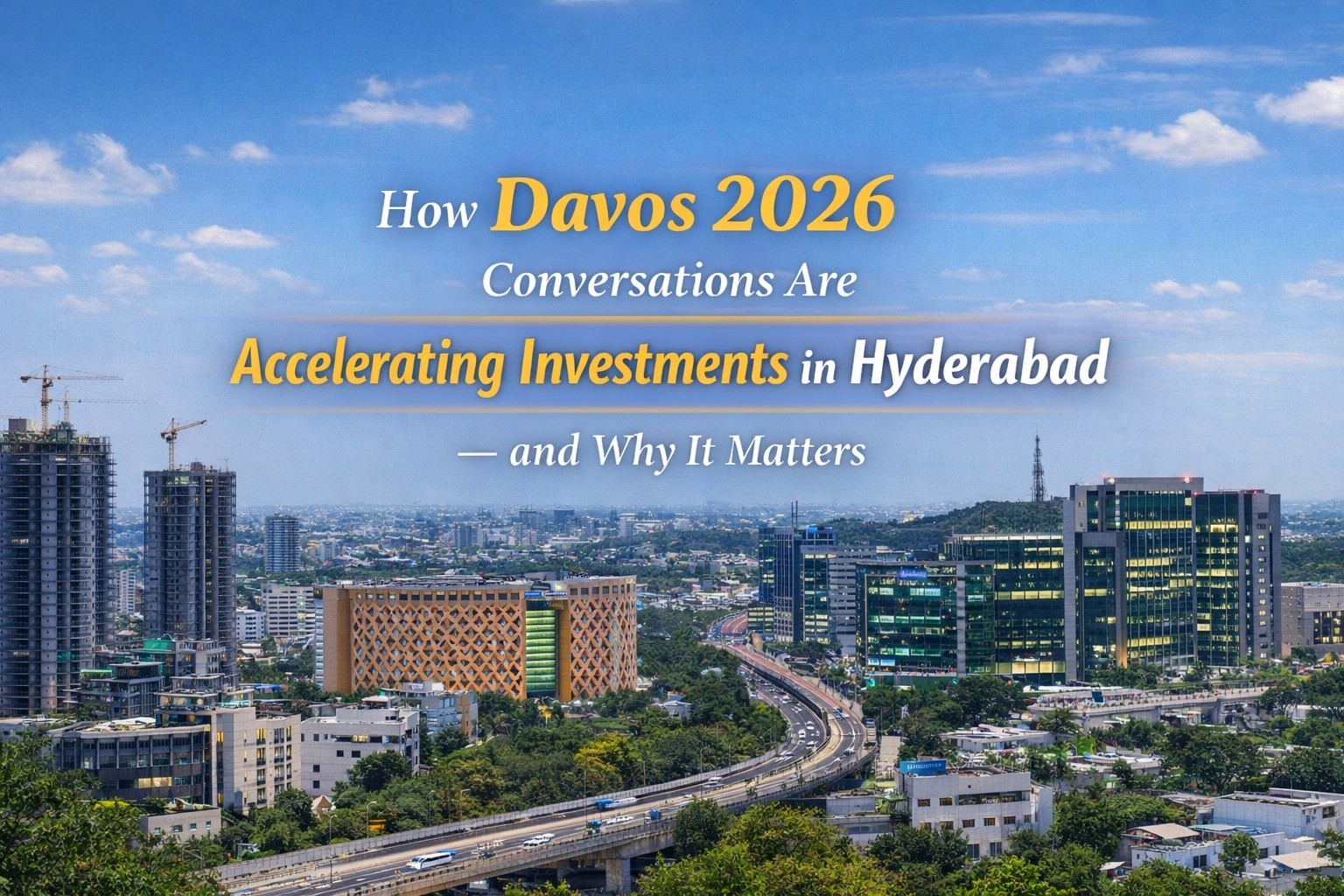
Hyderabad has quietly shifted from being India’s "IT services" powerhouse to a magnetic hub for global strategic investment. The recent discussions and deals emerging from the World Economic Forum (WEF) meetings in Davos have crystallized that shift — not as a one-off publicity moment, but as a turning point that’s already reshaping the city’s economic landscape. Below I unpack what’s happening, why it matters, and how Hyderabad can maximize the opportunity.
Global corporates and institutional investors attending the World Economic Forum in Davos are no longer asking, “Is Hyderabad on the map?” — they’re asking, “How fast can we scale here?”
Conversations at the World Economic Forum have translated into concrete interest from multinational firms across sectors such as beauty-tech, FMCG, AI, healthcare, and Global Capability Centre (GCC) operations. These discussions have produced announcements and exploratory commitments pointing to large-scale investments, high-skill job creation, and long-term institutional partnerships.
The World Economic Forum acts as a convergence point — where government policy, global capital, and corporate strategy align. The signals emerging from Davos suggest five deep structural shifts for Hyderabad:
Historically, Hyderabad built its reputation on IT services and BPO operations. What Davos signals is a maturation: global firms want to locate R&D, product engineering, and advanced analytics teams here — not just delivery centres. That means higher-value work (AI models, product design, domain-specific engineering) will increasingly be rooted in local teams, raising the average job profile and salaries.
Several large corporations are exploring or deciding to establish GCCs in Hyderabad — these hubs centralize functions like product engineering, analytics, cloud operations, UX, and regional strategy. GCCs act as long-term, sticky investments: once a company sets up engineering and leadership roles, its ecosystem — vendors, startups, talent pipelines — deepens around the city.
Davos isn’t just producing more IT jobs; it’s attracting investment in new verticals. Announcements around beauty-tech hubs, life sciences policy upgrades, AI innovation platforms, and healthcare partnerships show Hyderabad’s sector mix is changing — broadening the city’s resilience against shocks in any single industry.
Perhaps the most consequential shift is human capital: when companies bring leadership roles, R&D, and high-end engineering work to Hyderabad, it reduces brain drain. Talented engineers, scientists, and managers will increasingly find global career paths at home — and the city will retain talent that otherwise would have moved to Bengaluru, Singapore, or abroad.
Davos has amplified government messaging (Telangana Rising), new sectoral policies, and public innovation platforms (like AI hubs and life-sciences policy 2.0). When policy direction and private capital align — incentives, infrastructure, and regulation — investments move faster and at scale. (The New Indian Express)
Several high-profile signals discussed around the World Economic Forum at Davos matter because they are both symbolic and substantive:
L’Oréal’s beauty-tech hub announcement — a major commitment to invest in Hyderabad’s tech ecosystem for beauty and AI-driven product innovation. This is an example of a non-traditional IT firm choosing Hyderabad for high-end tech work, creating both tech jobs and domain-specific talent pools. (Reuters)
Unilever exploring a GCC — FMCG majors evaluating Hyderabad for global or regional capability centres is a strong sign that the city’s appeal goes beyond tech — into supply chain, operations, and product innovation. (The Times of India)
Telangana AI Innovation Hub and Life Sciences Policy 2.0 rollouts — government-led platforms and updated policies that provide the scaffolding for private investments in AI and biotech to scale rapidly. (The New Indian Express)
These commitments signal a shift from exploratory talks to planned implementation — land allocation, talent development, and policy incentives are now being discussed and codified.
4. Why this matters: five downstream impacts for Hyderabad
High-value job creation
The type of roles coming to Hyderabad (AI scientists, product managers, clinical research roles, beauty-tech engineers) pay at higher bands and create leadership pathways for local talent. This changes household incomes, consumer patterns, and city demand for premium services and housing.
Talent ecosystem stickiness
When real R&D and leadership roles exist locally, the pipeline of students, startups, and returning talent strengthens — colleges and training institutions revise curricula, startups find market-fit faster, and the overall skill base deepens.
Startup and supplier growth
GCCs and corporate R&D centers create demand for local suppliers: design firms, data annotation services, device prototyping, clinical trial firms, and AI startups. This creates a virtuous circle: corporates need suppliers; suppliers hire; startups get customers.
Infrastructure and urban development
Large investments require power, data centers, transport, and office real estate. This incentivizes both private and public investment in smart infrastructure, logistics, and sustainable urban planning — producing long-term improvements in livability.
Brand and diplomatic leverage
When global brands establish a foothold, Hyderabad’s brand improves internationally. That attracts further investment, tourism, and academic collaborations — and it can be leveraged in trade/diplomatic missions.
Such macro investments strengthen the role of leading real estate companies in Hyderabad operating in future-ready locations.
No boom is risk-free. Hyderabad must manage the following proactively:
Talent bottlenecks: Rapid hiring can outpace the availability of experienced leaders. Upskilling and targeted leadership programs are essential.
Real-estate and cost inflation: Demand for premium office and residential space can push up costs, making it harder for local startups and mid-size firms — careful zoning and affordable workspace policies help.
Over-dependence on a few corporates or sectors: Diversify across sectors and company sizes to avoid vulnerability if one industry cools.
Sustainability and infrastructure strain: Water, power, and transport need concurrent scaling — green infrastructure and circular economy investments should be prioritized.
For government
Fast-track clearances for high-impact projects and provide a single-window support for GCCs and R&D centres.
Public–private skills partnerships: tie universities, polytechnics, and industry to co-create leadership and AI curricula.
Affordable innovation real estate: incubators, lab space, and maker spaces subsidized in strategic zones.
Sustainability mandates: make large investments contingent on green building, water recycling, and local employment targets.
For corporates
Invest in local leadership: hire and train local P&L owners and R&D leads to embed long-term commitment.
Engage with local universities: joint labs, fellowships, and capstone projects to reduce hiring friction.
Use local suppliers: commit to local procurement to catalyse supplier ecosystems.
For startups & talent
Position for enterprise partnerships: build products and services that solve problems for GCCs and R&D centers (e.g., AI ops, clinical data platforms, beauty-tech tooling).
Upskill in domain specialties: AI for life sciences, computational chemistry, product engineering for hardware/software convergence.
Network with incoming corporates: seek pilot projects, proof-of-concepts, and vendor relationships.
Number of GCCs and corporate R&D centers established in next 24 months.
High-skill job creation (AI, data science, clinical research) measured annually.
Startups funded that cite corporate partnerships as initial customers.
University–industry collaborations (labs, patents, joint publications).
Infrastructure projects completed — datacenters, power reliability improvements, green initiatives.
Hyderabad’s strengths — a strong legacy of IT services, relatively lower operating costs than some metro peers, world-class healthcare and pharma clusters, and a growing policy push for AI and life sciences — give it a rare combination. If the city and state convert Davos interest into measurable projects (corporate commitments, campus builds, policy action, and talent development), Hyderabad can become a global centre not only for software but for product-led innovation across multiple verticals.
The World Economic Forum provided the room where the conversations happened. The real test — and the real transformation — will be judged by what gets built in Hyderabad: the labs, the GCCs, the career ladders, the startups that become global suppliers, and the city infrastructure that supports them.
For Hyderabad, the opportunity is clear: convert World Economic Forum interest into execution — attract strategic investments, retain global talent, and build ecosystems that allow international companies not only to set up here, but to truly belong here.