Managed Farmland near Hyderabad: A New Kind of Investment That Grows with Time
Mar 21, 2026
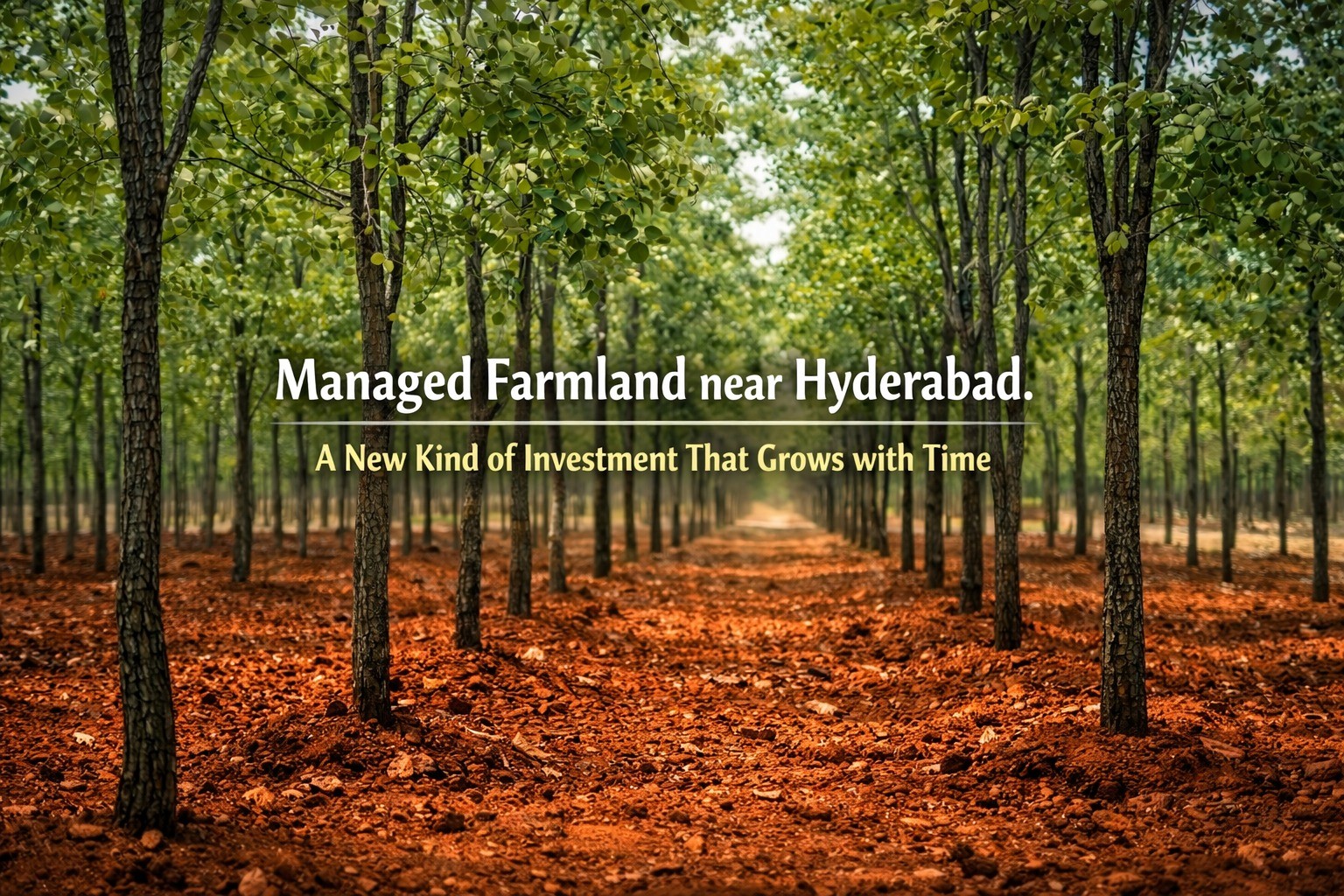
Hyderabad is a city that never stops growing.
New companies arrive every year. IT parks expand. Residential towers rise quickly. Opportunities keep increasing, and the city continues to attract people from across the country.
But along with this growth, something else is happening quietly among investors.
Many people who once focused only on apartments or urban plots are beginning to look at a completely different kind of asset — agricultural land.
More specifically, they are exploring Managed Farmland near Hyderabad.
Not because they want to become farmers.
But because farmland offers something that modern investments often miss: patience, stability, and natural growth over time.
Why Investors Are Looking Beyond Concrete Assets
For decades, real estate investment mostly revolved around apartments and residential plots.
While these investments still play an important role, many investors are starting to notice a few realities:
• Apartments gradually age
• Maintenance costs increase every year
• Rental yields can be unpredictable
• Urban real estate markets are becoming crowded
As a result, investors are searching for assets that can hold value over longer periods while remaining relatively stable.
This is where agricultural land becomes interesting.
Land does not depreciate like buildings. In many cases, its value increases as surrounding regions develop.
When combined with plantation farming and professional management, farmland becomes more than just land — it becomes a long-term wealth-building asset.
The Emotional Value of Owning Land
There is something timeless about owning land.
Unlike stocks or digital investments, farmland is something you can actually experience.
You can walk through it.
You can see trees grow year after year.
You can visit it with your family.
For many investors, farmland represents security and legacy.
Parents often say that land is one of the few assets they feel confident passing down to the next generation. It holds both financial and emotional value.
That’s one reason Managed Farmland near Hyderabad is becoming increasingly attractive for long-term investors.
How Managed Farmland Makes Agricultural Investment Simple
Traditionally, farmland ownership required deep farming knowledge.
You had to manage irrigation, labor, soil health, crops, and harvest cycles. For people living in cities, this was simply not practical.
Managed farmland changes that completely.
In this model, professional teams handle the agricultural operations. These teams take care of plantation planning, irrigation systems, soil care, and maintenance.
Investors simply own the land while experts manage the farming activities.
This system allows professionals, entrepreneurs, and NRIs to participate in agricultural investments without needing farming expertise.
It transforms farmland into a structured investment opportunity.
The Growing Demand for Plantation-Based Farmland
One of the reasons farmland investments are becoming more attractive is the rise of plantation-based agriculture.
Instead of focusing only on seasonal crops, many managed farmland projects include long-term plantation trees.
Trees grow steadily over time, and as they mature, their value increases.
This slow but consistent growth makes plantation farming appealing for investors who prefer patient, long-term wealth creation rather than short-term speculation.
Plantations also improve soil health, support biodiversity, and create greener landscapes.
In many ways, plantation farming aligns with the future of sustainable investment thinking.
Why Hyderabad Is an Ideal Location for Farmland Investment
Hyderabad has experienced remarkable growth over the last two decades.
From IT corridors and global companies to infrastructure projects and expanding suburbs, the city continues to develop rapidly.
As cities expand outward, nearby agricultural land naturally becomes more valuable.
Investors who understand long-term land appreciation often pay attention to regions that are still developing but have strong growth potential.
This is why farmland surrounding Hyderabad has started attracting attention from people looking for stable, long-term investments outside the crowded urban market.
An Example of Modern Managed Farmland Development
Several organized farmland projects are emerging around Hyderabad that combine land ownership with structured plantation development.
One such example is Charan’s Sandalwood Gardens, a managed farmland initiative focused on red sandalwood plantation.
The project spans 12 acres in total, with Phase 1 covering 4 acres, and is located just 1 km from NIMZ Main Road, Zaheerabad.
Within the farmland layout, investors can own smaller agricultural plots that include professionally maintained red sandalwood plantations, with around 10 plants per gunta.
The project offers limited plots, including 3-gunta east-facing plots and 2-gunta west-facing plots, along with a few commercial plots, all connected by 25-foot internal roads with border plantation and greenery development.
Projects like these represent how farmland investment is evolving — becoming more organized, accessible, and structured for modern investors.
A Different Kind of Investment Journey
Most investments today move quickly.
Markets rise and fall. Prices change rapidly. Investors often chase short-term gains.
Farmland works differently.
It grows slowly. Naturally. Quietly.
Trees take time to mature. Land appreciates gradually as surrounding regions develop. Over the years, patience often becomes the biggest advantage.
This is why many experienced investors describe farmland as a long-term journey rather than a short-term trade.
And for people who value stability, nature, and long-term planning, this journey can be incredibly rewarding.
Frequently Asked Questions
1. What is managed farmland?
Managed farmland allows investors to own agricultural land while professional teams manage plantation, irrigation, and farming operations.
2. Why is farmland considered a long-term investment?
Land is a limited resource, and its value often increases as nearby regions develop. Plantation farming can also add long-term value.
3. Do investors need farming knowledge?
No. In managed farmland models, agricultural experts handle farm management and plantation care.
4. Why is farmland near Hyderabad attracting attention?
Hyderabad’s rapid infrastructure growth and expanding urban boundaries make nearby land increasingly valuable over time.
5. What types of plantations are common in managed farmland projects?
Many projects focus on plantation crops such as sandalwood or other long-term trees that increase in value as they mature.
6. Can farmland be used as a family asset?
Yes. Many investors view farmland as a legacy asset that can be passed on to future generations.
Conclusion
Investment opportunities evolve with time, but some assets remain timeless.
Land is one of them.
As Hyderabad continues to grow, many investors are beginning to recognize the potential of Managed Farmland near Hyderabad as a long-term asset.
It offers a rare combination of stability, natural growth, and emotional connection.
Unlike fast-moving financial markets, farmland reminds investors of something important — that the best investments are sometimes the ones that grow patiently with time.
And just like the trees planted on the land, their value often becomes visible only to those who are willing to wait.